Double Door & Tunnel Shipping Containers
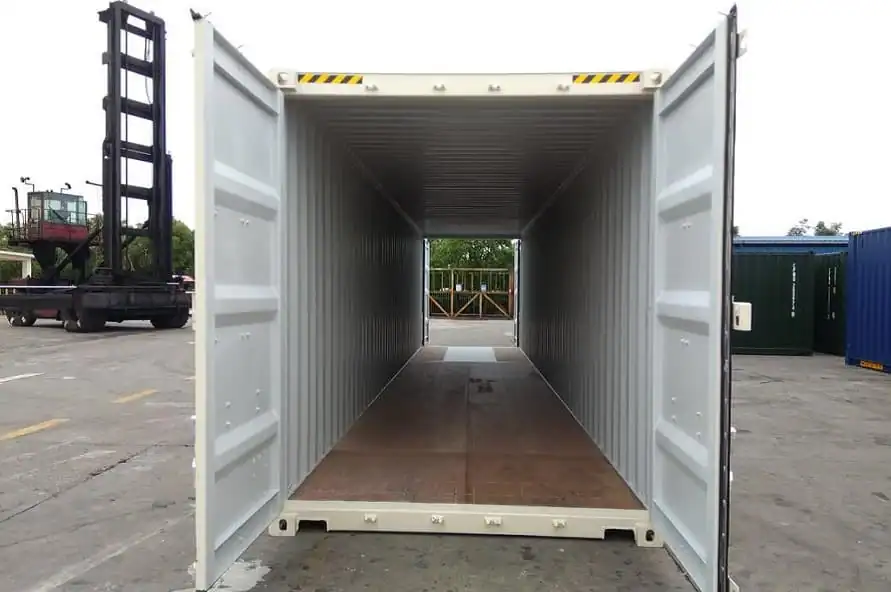
A tunnel container has the standard cargo doors at both ends instead of one. Open both and you can see straight through, walk straight through, and load straight through.
People also call it a double door container, a double-ended container, or a drive-through container. All the same thing.
Two ways to get one, and they are not equivalent
| Factory-built tunnel container | Second door set cut in later | |
|---|---|---|
| How it is made | Manufactured with door frames at both ends from the start | The solid end wall is cut out and a door frame welded in |
| CSC plate | Keeps it — still certified for international cargo | Loses it — structurally modified, no longer certified |
| Fit and seal | Factory gaskets and tolerances on both ends | Depends entirely on the quality of the fabrication |
| Availability | Less common than a standard container, so stock moves | Can be done on almost any sound container |
| Best when | You want a clean product and may ship it one day | You already own the container, or you want a non-standard opening |
If you only need a way in that is not the back doors, a side door or a roll-up door is usually cheaper and keeps the end wall intact.
What people actually use them for
- Drive-through loading. A forklift goes in one end and out the other instead of reversing 40 feet down a dark box.
- Long material. Pipe, lumber, conduit and rebar can be fed in from one end and pulled out the other without turning anything around.
- Splitting one container between two users. Two crews, two tenants, or two departments each get their own end and their own lock. This is the reason we hear most often.
- Access from either side of a fence or a row. If the container has to sit in line with others, you are not stuck with whichever end happens to face the aisle.
- Ventilation while working inside. Both ends open gives real cross-flow, which a single-ended container never does.

What you give up
No side access. Both openings are at the ends. If you need to load from the long side, you want a side door instead, or as well.
A little less rigidity. On a standard container the solid corrugated end wall helps brace the box. A tunnel container has a door frame at both ends instead, so it is slightly less stiff. It is still a shipping container and it is still strong — but it matters more that it sits level and is supported at all four corner castings. See delivery and site preparation.
Two ends to keep sealed. Twice as many gaskets and lock rods to keep in condition. Not a problem, just twice the maintenance.
Sizes
Tunnel containers are most common in 40ft, because the drive-through and split-in-two uses need the length. 20ft tunnel containers exist and are worth it mainly for the two-users case. High cube versions of both are available in either factory or modified form.
Common questions
Is a tunnel container the same as a double door container?
Yes. Tunnel, double door, double-ended and drive-through all describe a container with cargo doors at both ends.
Can a tunnel container still be shipped overseas?
A factory-built one can — it keeps its CSC plate. One that has had a second door set cut in afterwards cannot, because structural modification voids the plate.
Is it weaker than a normal container?
Slightly less rigid, because there is no solid end panel. It is still rated as a container and is fine for normal use, provided it sits level on all four corners.
Can I lock each end separately?
Yes. Each door set has its own lock rods and can take its own lock box, which is what makes the two-users arrangement work.
Can you convert a container I already own?
Yes, if it is sound. Send photos of the walls, floor, roof and the end you want cut, and we will tell you honestly whether it is worth doing.
Does it cost more than a standard container?
Yes, either way — a factory tunnel container is a less common build, and a cut conversion is fabrication labour. Tell us the size and grade and we will quote the actual number.
Where to start
- 40ft containers — the usual base for a tunnel build.
- 20ft containers — for the split-between-two-users case on a smaller footprint.
- All modifications — doors, windows, vents, insulation, electrical and paint.
- Conex box — if that is the word you use, it is the same container.
Tell us the size, whether you want factory-built or converted, and the delivery zip code. We are based in Pasadena and deliver on our own trucks across Los Angeles and the rest of California.
Free Quote · No Obligation
Get a price for this container
Tell us where it is going and we will send you a delivered price. We have already filled in the size you were looking at — change it if you need something else.
"*" indicates required fields