What Is a Conex Box?
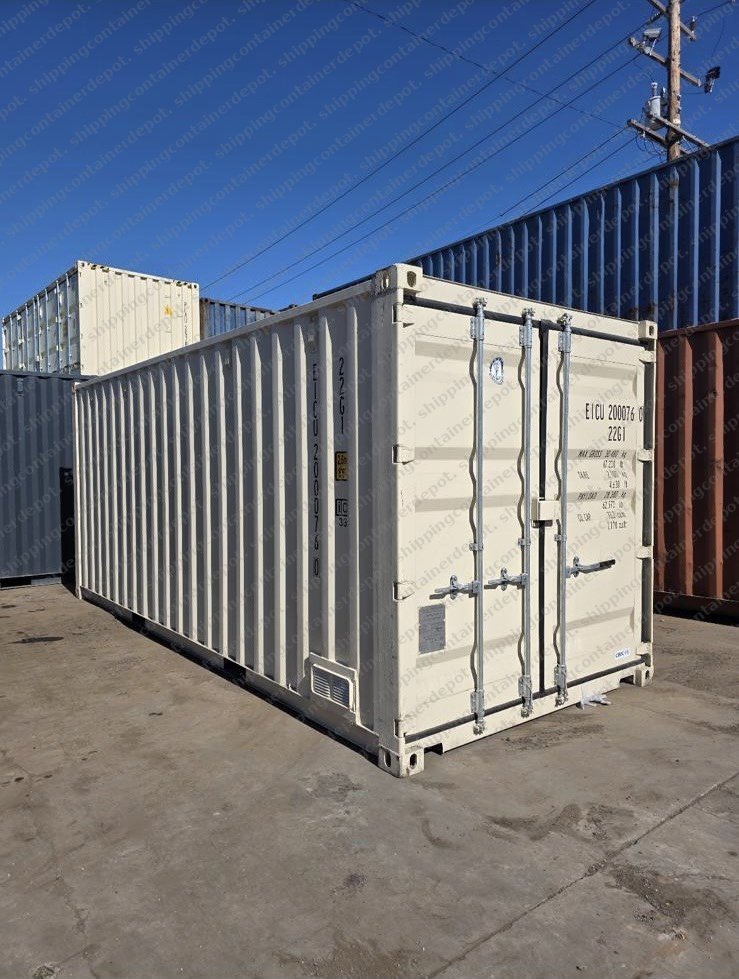
A conex box is a steel shipping container. The two words describe the same object — a corrugated steel box built to ISO standards, stackable, lockable, wind and watertight, and strong enough to be lifted full and trucked across the country. If someone quotes you a conex box and someone else quotes you a shipping container, they are quoting the same thing.
What differs is who is speaking. “Conex” is the older American term, and it is still the everyday word on military bases, government sites, farms and job sites across much of the United States. “Shipping container” is what the shipping industry says. You will also hear connex box (a common misspelling), conex container, seacan, cargo container and ISO container for the same box.
Where the name comes from
CONEX is short for Container, Express. The system was developed in late 1952 by the U.S. Army Transportation Corps, building on an earlier reusable steel box called the Transporter that had been introduced in 1948 and proved itself moving supplies during the Korean War.
The original CONEX box was much smaller than what you would buy today: roughly 8ft 6in long, 6ft 3in wide and 6ft 10in high, rated to carry about 9,000 lb. A half-size version was also made. The idea behind it — pack once, move by truck, rail and ship without repacking — is the idea that Malcolm McLean turned into the modern intermodal container, standardised as ISO 668 and ISO 6346.
So the name outlived the box. When a customer today asks for a conex box, they mean a modern ISO container, usually 20ft or 40ft.
Conex box, shipping container, seacan — which word is right?
| Term | Who uses it | Means |
|---|---|---|
| Conex box / conex container | Military, government, agriculture, construction, much of the southern and central US | A standard steel shipping container |
| Connex box | Common spelling variant of the above | The same thing |
| Shipping container | Shipping and logistics industry, most sellers | The same thing |
| Seacan / sea container | Canada and the northern US | The same thing |
| ISO container | Technical and regulatory use | A container built to ISO 668 dimensions and ISO 6346 marking |
Conex box sizes
Every size below is 8ft wide. Height is 8ft 6in as standard, or 9ft 6in on a high cube. Only the length really changes.
| Size | External L × W × H | Typically used for |
|---|---|---|
| 10ft conex box | 10ft × 8ft × 8ft 6in | Tight lots, small yards, tool and equipment storage |
| 20ft conex box | 20ft × 8ft × 8ft 6in | The default on-site size. Fits most driveways and job sites |
| 40ft conex box | 40ft × 8ft × 8ft 6in | Bulk storage, warehousing overflow, long items |
| 40ft high cube | 40ft × 8ft × 9ft 6in | One extra foot of interior height — conversions, tall pallets |
| 45ft high cube | 45ft × 8ft × 9ft 6in | Maximum volume where access allows a 45ft delivery |
Interior measurements, door openings, tare weight and payload for each size are on our shipping container dimensions page.
Conex box conditions
Condition is what actually moves the price, far more than size. The grades below are the ones the industry uses.
- One-trip — loaded once at the factory and shipped to the US. Straight walls, clean paint, no rust. Effectively new.
- Cargo worthy (CW) — certified fit for international cargo. Dents and paint wear, but structurally sound and sealed.
- Wind and watertight (WWT) — no longer cargo certified, still dry inside. The usual choice for on-site storage.
- As-is — sold with a known fault. Cheapest, and only sensible if you know what the fault is.
Used conex boxes are graded by these terms, so ask which grade a quote refers to before comparing two prices.
What people use conex boxes for
- On-site storage — tools, materials and equipment locked up on a job site or behind a business.
- Overflow warehousing — cheaper per square foot than renting more indoor space, and it sits on your own lot.
- Agriculture and ranch storage — feed, tack and machinery, out of the weather and away from rodents.
- Government and military — where the word conex is still standard, usually bought to a specified grade.
- Conversions — offices, workshops, and builds with side doors or roll-up doors cut in.
- Refrigerated (reefer) containers — insulated and powered, for cold storage rather than dry goods.
Buying versus renting
Buy if the container will stay put for more than about a year, if you want to modify it, or if you want the asset. Rent if the need is tied to a project with an end date, or if you would rather not deal with reselling it afterwards. Delivery works the same either way — see delivery and site preparation for the space a truck needs.
Common questions about conex boxes
Is a conex box the same as a shipping container?
Yes. Same object, different word. Conex is the older American term and it stuck; the shipping industry says shipping container.
Why is it called a conex?
CONEX is short for Container, Express — a US Army system developed in late 1952, descended from the 1948 Transporter box used during the Korean War.
Is it spelled conex or connex?
Conex is the correct spelling, from Container Express. Connex is a very common variant and people searching either way mean the same box.
What sizes do conex boxes come in?
10ft, 20ft, 40ft and 45ft are standard, in either 8ft 6in standard height or 9ft 6in high cube. All of them are 8ft wide.
How much does a conex box weigh?
A 20ft weighs roughly 5,000–5,200 lb empty and a 40ft roughly 8,500 lb. Exact figures per size are on our dimensions page.
Can I put a conex box on my property?
It depends on your city or county, not on the container. Some jurisdictions treat it as an accessory structure and require a permit; others have no container ordinance at all. Our city pages set out the rules where we deliver.
Are conex boxes waterproof?
A wind and watertight or better container keeps rain out. Condensation is a separate issue and is handled with vents or insulation, not with a better door seal.
Getting a conex box in Southern California
We are based in Pasadena and deliver on our own trucks across Los Angeles and the rest of California. Tell us the size, the grade and the delivery zip code and we will come back with a firm number.